Director: William Wyler

Alex – 7.9 Elliot – 7.9 IMDB 7.7 Rotten Tomatoes 7.6
Alex’s Commentary:
It seems fitting that I pen my Mrs. Miniver commentary on Memorial Day 2012 given the movie’s patriotic theme. Director William Wyler acknowledged he made the film as a propaganda vehicle to encourage American support against the Nazi aggression in Europe. He portrays the idyllic pastoral life of the English Miniver family in the months leading up to the German attack on England, and the dramatic upheaval the family and their town faces as England enters World War II.
The Joseph Ruttenberg award-wining black and white cinematography is superb, and the interior scenes of an upper-middle class British household are beautiful. The prologue describes the Miniver household as an average English middle-class household but their extravagant purchases of clothing and a luxury automobile belie that description. The attractive Greer Garson claims Best Actress honors for her strong portrayal of Mrs. Miniver.  The Oscar winning screenplay crafted by a team of four writers trace Mrs. Miniver’s evolution from a housewife whose primary concern is clothes shopping, to a concerned mother of a fighter pilot and ardent supporter of the British war effort. Some of the more memorable scenes include Mrs. Miniver’s capture of a German parachutist, aerial battles, and the anxious family’s hunkering down in their bomb shelter unsure if the next bomb could be a direct hit or if their house would still be standing when they emerged.
Walter Pigeon is well cast as Mr. Miniver. He joins the community effort to help rescue trapped British troops at Dunkirk, while his wife is left behind worry about his return. The town faces a series of air raids, blackouts and, inevitably, the death of many innocent civilian villagers, young and old. Teresa Wright took home Best Supporting actress honors as the ill-fated love interest for Mrs. Miniver’s RAF son, 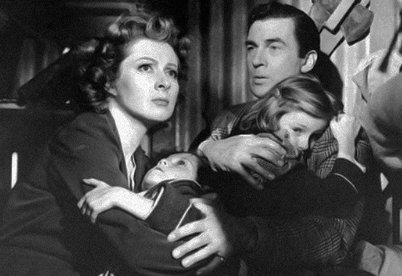 Vincent. I also enjoyed the side story of the annual town flower show and the town’s determination not to let the war cancel the festivities.
This film was the number one box office hit of 1942 as its patriotism resonated with American audiences. Winston Churchill even commented that the film was worth more to his nation than a dozen battleships, and President Franklin D. Roosevelt encouraged all Americans to view the film. While we have viewed films with war-time themes, Wings, All’s Quiet on the Western Front and Cavalcade, this is our first film that was actually produced in the time of the war being portrayed. Although I don’t consider the film ground-breaking and at times it is predictable; nevertheless, Mrs. Miniver is interesting in its historical context.
Elliot’s Commentary:
1942’s Best Picture winner, Mrs. Miniver, is our first film to be released after the United States joined WWII. Interestingly enough, rather than tackle the war through an American perspective, the film is based on the home life of a middle-class English family. This film has aspects of many genres melded together to portray a strong and resilient family attempting to adapt to the constraints of war. Directed by William Wyler, Mrs. Miniver acts as both war-time propaganda as well as a heart-warming family drama. The film incorporates beautiful symbolism and metaphors in their story-telling as the family deals with real destruction on the home front.  Seeing the destruction in lives of fellow Allied countries was a good tool to incite more of a response from people in the United States, who didn’t have to deal with the nightly blitzkriegs of their allies. One of my favorite scenes in the film involves the family gathered for safety in a bomb shelter reading out scenes from Alice’s Adventures in Wonderland. It seems as if the war had brought the family down the rabbit hole, and it was impossible for the family to not use escapism as they prayed for their safe keeping during the raid.
Mrs. Miniver works on a variety of levels, the first of which being an impassioned albeit abbreviated love story between the Miniver’s altruistic son Vin Miniver (Richard Ney), and the aristocratic granddaughter of Lady Beldon, Carol Beldon (Teresa Wright). While the couple does not have much exposition allotted for their courting period, they decide to get married due to the circumstances of the war. It’s hard for your heart not to break hearing Carol describe that she needs to spend as much time with Vin as possible, because she is not sure how much longer her airplane flying husband can dodge death’s fateful grasp.
Another layer of the story is the flower show held in town, with the prodigious prize for best rose usually claimed by Lady Beldon (Dame May Whitty), who is Carol’s grandmother. However, this year the local stationmaster Mr. Ballard (Henry Travers) has cultivated a beautiful competing red rose, named the Mrs. Miniver, to compete against Lady Beldon’s white rose. There is an interesting discussion of class between Carol, Vin, and the Miniver clan as Carol asks for the competing rose to be removed from the competition. While it was a tradition for Lady Beldon to win the prize, it shows a distinct breaking down of traditional classes for a lay person like Mr. Ballard to compete on the same level as the local nobility. After all, there is no place for class distinction in war and this movie is about the breaking down of individual concerns for the greater good. I also feel that it is prudent to emphasize the importance of the red rose in the mythology of England. The red rose is a symbol of England, similar to the bald eagle’s significance in the American cultural pantheon. By naming the ultimate victor of the competition the commoner’s cultivated red rose, it shows the importance of the underdog English overcoming the evil empire of Nazi controlled Germany.  The rose’s name being Mrs. Miniver shows that she is a true symbol of England, as she keeps her house together despite both her husband and son’s military commitments. There is also a famous scene in which she is confronted by a wounded Nazi pilot and is able to subdue him and call the authorities.
Mrs. Miniver was a fantastic and moving film for a variety of reasons, but most importantly is the ability for Hollywood to continue to thrive in a rationed wartime environment. Greer Garson has a fantastic acting performance in the role of Mrs. Miniver, and rightly earns the Best Actress Oscar for 1942. While I will avoid spoilers in this review, I do have to say that the movie does a fantastic job at surprising the audience in terms of loss and sorrow, while at the same time uplifting a country in the midst of war. Under different circumstances, it would be hard to say if Mrs. Miniver would have been the best film of the year. However, in these trying times the film was exactly what America needed to inspire its population engaged in one of the bloodiest conflicts in the history of the world.

 However, I think my expectations were too high. I knew this film had received 10 Oscar nominations and had won the awards for Best Picture, Best Director, Best Cinematography Black & White, Best Actor in a Supporting Role (
 Of course, 11 year old
  The film was originally slotted to be shot in Technicolor and in Wales but war prevented that dream from being realized, and the Welsh mining village was instead built on a studio lot. This film was surprisingly political, and showed a clear favoritism towards the idea of unionization. Not that I am against that concept in any capacity, but I’m sure some would have called the film socialist propaganda.
 The fact that the village was built on a set, makes the grandeur of the shots even more impressive. I also really enjoyed the singing of the miners, which provided an element that helped make the story feel more genuine. I will admit that half of the reason I haven’t included many character names in this review is the fact that Welsh is a very difficult language to understand, and there are points in the film where I have no idea what the characters are even saying. Subtitles would have provided a nice compliment to the Welsh utilized in the film, and would definitely have made the audience feel more like insiders than outsiders. How Green Was My Valley is not as timeless as its contemporaries Citizen Kane and The Maltese Falcon, but if you would like to see a romance/drama set in a turn of the century Welsh mining town, then this film is right up your alley.
 It may just be my imagination but it seems that when the film is lighter in tone, the images are not as sharply contrasting as compared to the more exciting, suspenseful scenes that contain more extreme black and white shots. As with many of the films we’ve viewed to date, rain scenes are abundant. I was surprised at the lack of technical sophistication in certain shots, particularly those in the automobile with the obviously fake backgrounds.
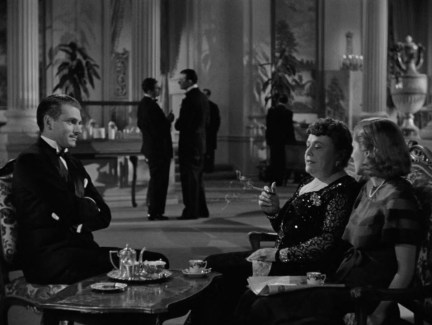 During her brief freedom, the young woman begins to spend time with the widower, Maximilian de Winter (
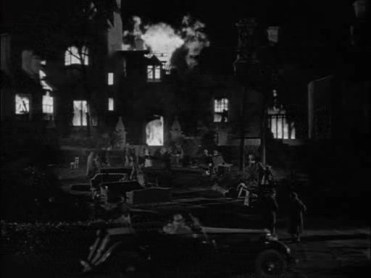 I certainly could not have predicted the chain of events that lead up to the destruction of Manderley. I also am not giving away any spoilers, because we are aware of the estate’s demise in the first scene of the film. I never read the Daphne du Maurier novel that the film was based on, but preliminary research indicates that the film was very true to the novel minus a few liberties it took to be in compliance with the production code. Hitchcock would go on to direct another classic film based on a
  The Kindler Oscar Chronicles