Director: Michael Curtiz

Alex – 9.5 Elliot – 10.0 IMDB 8.7 Rotten Tomatoes 9.0
Alex’s Commentary:
Where does one begin when reviewing Casablanca and how high do I rate it? Given that it is probably my favorite movie to date, I might be tempted to give it a 10; however, as we still have almost 70 years remaining on our cinematic journey, a 9.5 feels appropriate. Casablanca has everything going for it – a great story, great acting, great directing, great cinematography, even great music. Obviously, I think this movie is great!
Set in World War II Casablanca, the story revolves around refugees of varied socioeconomic backgrounds attempting to flee war-torn Europevia letters of transit obtained through whatever means possible.  But this story is merely a backdrop for the real story, the ill-fated love triangle of Rick Blaine (Humphrey Bogart), Ilsa Lund (Ingrid Bergman) and Victor Laszlo (Paul Henreid).
The dialogues are replete with expressions that have become part of the everyday vernacular or are simply remarkably memorable – “here’s looking at you kid”; “Of all the gin joints, in all the towns, in all the world, she walks into mine”, “I remember every detail. The Germans wore gray, you wore blue”; “We musn’t underestimate “American blundering”. I was with them when they “blundered” into Berlinin 1918”; ”Well there are certain sections of New York, Major, that I wouldn’t advise you to try to invade”; “Louie, I think this is the beginning of a beautiful friendship”; and of course the quote that was never actually said “Play it again Sam.”
I had forgotten how entertaining the Epstein Brothers screenplay was encompassing both humor and poignancy. The film is only 102 minutes but feels even shorter given Curtiz’s rapid pacing of scenes. The juxtaposition of Rick and Ilsa’s flashback time in Pariswith current Casablanca is extremely effective. Max Steiner’s atmospheric score captures the cultures of Morocco,France and Germanywhile throwing in some “current” American standards for Sam and the band, most notably “As Time Goes By.”
Although none of the actors or actresses won any Academy Awards, stellar performances abound. Favorites among the cast members include Captain Louis Renault (Claude Rains), Major Heinrich Strasser (Conrad Veidt), Signor Ferrari (Sydney Greenstreet), Ugate (Peter Lorre), and of course, Sam (Dooley Wilson).
Casablanca is a must see on every film critics list and certainly on mine.
Elliot’s Commentary:
With the coming of the Second World War, many eyes in imprisoned Europe turned hopefully, or desperately, toward the freedom of the Americas. Lisbon became the great embarkation point. But, not everybody could get to Lisbon directly, and so a tortuous, roundabout refugee trail sprang up – Paris to Marseilles… across the Mediterranean to Oran… then by train, or auto, or foot across the rim of Africa, to Casablanca in French Morocco. Here, the fortunate ones through money, or influence, or luck, might obtain exit visas and scurry to Lisbon; and from Lisbon, to the New World. But the others wait in Casablanca… and wait… and wait… and wait.
There are so many things that are wonderful about the film Casablanca, that it is hard to properly organize one’s thoughts. Casablanca has been enshrined in our minds as the quintessential film of classic Hollywood for a reason, and I am at a loss to name a single fault in the film. It is a film that defies genre classification, and its universal appeal is hard to replicate. In all honesty, I wouldn’t be able to name a single city in Morocco if this film hadn’t put the city of white houses on the map. The genius behind this cinematic masterpiece, director Michael Curtiz, also brought us the classic films Yankee Doodle Dandy, Angels with Dirty Faces, and White Christmas. Curtiz provided the next step from 1942’s Mrs. Miniver, and used the global conflict as the background to frame a larger plot around rather than produce another propaganda film. Curtiz didn’t really need to worry about making propaganda films, because Frank Capra was taking charge of that realm of filmmaking with the Why We Fight series. To try and distill the reason why Casablanca remains one of the best motion pictures of all time into one specific reason, would be a futile and pointless effort. Casablanca is the product of the universe aligning to provide an example of what happens when every fixture of a film works in perfect harmony to create a visual opus.
It is hard to imagine that I wrote a paragraph on the film without mentioning the inimitable Humphrey Bogart.  When I hear someone say Bogey, I don’t think about golf, I think about this magnificent man. The majority of the film’s action takes place in Rick’s Café Américain, and Bogey plays the proprietor of the establishment, Rick Blaine. I do not think that anyone who has ever been born could play a better mysterious leading man with a concealed past and steadfast morals, than Bogey did. It was also a fantastic casting decision to have Peter Lorre play a supporting role to Mr. Bogart, in a reprise of their superb on-screen dynamic first exhibited in 1941’s Maltese Falcon.
The entire premise of the film involves life in the geographical purgatory of Casablanca, which is located along the escape route for French refuges seeking asylum in America. For many trapped in this French-owned African colony, life is about waiting to either escape toAmericaor for war to end. However, in this diplomatic gray area, most people must resort to using the black market to obtain the necessary documents and paperwork to ensure their exodus. In the mean time, Rick’s Café Américain provides a taste of Western culture in an otherwise barren landscape. While Rick adamantly tries to abstain from engaging in political matters concerning the growing divide between French loyalists and German officers, a series of events unfolds that forces him to rethink his role as Switzerland.
Rick’s suppressed past jarringly reemerges in the form of the incomparable beauty, Ingrid Bergman, who plays the character Isla Lund. Bergman is the perfect foil for Bogart’s character, because it takes a woman like her to shake Bogey’s cool. As the plot unravels, Isla and Rick had a tumultuous love affair in Paris before the Nazi occupation tore them apart.  While, I am not interested in spoiling the film, I do have to note that there were other forces than the Nazi’s that also played a part in their separate diasporas. However, after a couple of years have passed, Isla and her husband Victor Laszlo descend upon Rick’s purgatory seeking letters of transit to aid in their departure. Victor Laszlo is an extremely important figure in the underground, and publishes revolutionary newsletters that organize the resistance in Europe against Nazi occupation. As Victor and Isla arrive in the city, they head to the bastion of Western culture in the city, Rick’s Café Américain. This sparks Humphrey Bogart to deliver one of the most famous lines in cinematic history, “Of all the gin joints, in all the towns, in all the world, she walks into mine.”
Rather than spill out the rest of the plot summary that you can read on Wikipedia or IMDB, I want to highlight two of my favorite scenes of the film. The first of which, is a scene that contains the most moving presentation of the La Marseillaise (The French National Anthem) that has ever been portrayed in film. The scene is set in Rick’s and takes place after the arrival of Victor Laszlo. A group of German soldiers at Rick’s are inebriated at the bar, and begin singing the German national anthem. In the sake of full disclosure, I have no idea if it is the Nazi National Anthem or the German National Anthem. Victor Laszlo stands up in the bar and begins to sing La Marseillaise, and slowly more and more patrons of the bar join Laszlo in song. This leads to a cacophonous battle of music between the German soldiers and the stranded French citizens. Then, in a triumphant moment, the French song crescendos to completely drown out the German voices. This is the turning point of the film, and causes the politically abstinent Rick to realize the importance of Laszlo to the underground cause.
The second important part of this movie that I would like to highlight is the evolution of Hollywood in its portrayal of the black piano player, Sam (Dooley Wilson). Now I need to write a small concession before I explain myself, I am not saying that in 1943 Hollywood had finally overcame its issue of race portrayal in film. In fact, I am willing to argue the point that it still hasn’t overcome it. However, I want to applaud Casablanca for refusing to make Sam a caricature. 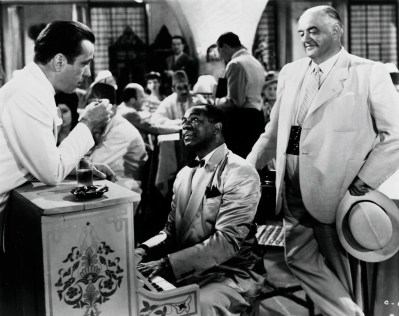 I understand that as one of the only black people in the movie, his portrayal of a piano player could tread the Gone With the Wind line and ignore the vibrant Black culture in America at that time. However, Casablanca very clearly denotes that Sam is a minority owner of Rick’s and that he and Rick have been lifelong friends. Also, Dooley Wilson is insanely talented and if I had unlimited money I would pay for his hologram to play As Time Goes By at my wedding. While race portrayals of most 1940’s films are still incredibly dated, a nice way of saying racist, it was at least nice to see that one screenwriter wrote a role that positively portrayed a black man in early Hollywood.
I know I have said this before in my review of Gone With the Wind, but this film trumps my previous recommendation. You must see this film. There hasn’t been a single film we have seen thus far that is as cinematically important or as well done as Casablanca is.

 The Oscar winning screenplay crafted by a team of four writers trace Mrs. Miniver’s evolution from a housewife whose primary concern is clothes shopping, to a concerned mother of a fighter pilot and ardent supporter of the British war effort. Some of the more memorable scenes include Mrs. Miniver’s capture of a German parachutist, aerial battles, and the anxious family’s hunkering down in their bomb shelter unsure if the next bomb could be a direct hit or if their house would still be standing when they emerged.
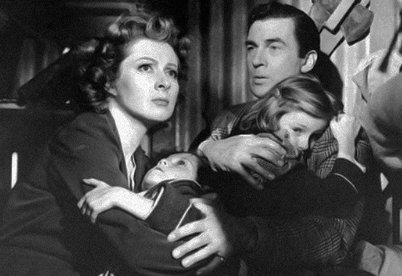 Vincent. I also enjoyed the side story of the annual town flower show and the town’s determination not to let the war cancel the festivities.
 Seeing the destruction in lives of fellow Allied countries was a good tool to incite more of a response from people in the United States, who didn’t have to deal with the nightly blitzkriegs of their allies. One of my favorite scenes in the film involves the family gathered for safety in a bomb shelter reading out scenes from
  The rose’s name being Mrs. Miniver shows that she is a true symbol of England, as she keeps her house together despite both her husband and son’s military commitments. There is also a famous scene in which she is confronted by a wounded Nazi pilot and is able to subdue him and call the authorities.
 However, I think my expectations were too high. I knew this film had received 10 Oscar nominations and had won the awards for Best Picture, Best Director, Best Cinematography Black & White, Best Actor in a Supporting Role (
 Of course, 11 year old
  The film was originally slotted to be shot in Technicolor and in Wales but war prevented that dream from being realized, and the Welsh mining village was instead built on a studio lot. This film was surprisingly political, and showed a clear favoritism towards the idea of unionization. Not that I am against that concept in any capacity, but I’m sure some would have called the film socialist propaganda.
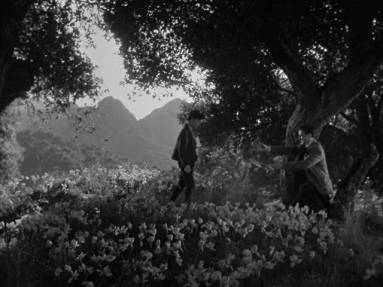 The fact that the village was built on a set, makes the grandeur of the shots even more impressive. I also really enjoyed the singing of the miners, which provided an element that helped make the story feel more genuine. I will admit that half of the reason I haven’t included many character names in this review is the fact that Welsh is a very difficult language to understand, and there are points in the film where I have no idea what the characters are even saying. Subtitles would have provided a nice compliment to the Welsh utilized in the film, and would definitely have made the audience feel more like insiders than outsiders. How Green Was My Valley is not as timeless as its contemporaries Citizen Kane and The Maltese Falcon, but if you would like to see a romance/drama set in a turn of the century Welsh mining town, then this film is right up your alley.
 The Kindler Oscar Chronicles