Director: Elia Kazan
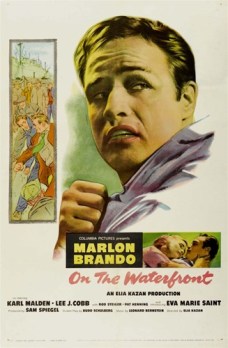
Alex – 8.7 Elliot – 8.8 IMDB 8.3 Rotten Tomatoes 9.2
Alex’s Commentary:
I love On the Waterfront. It is a compelling film from the opening minutes of a person being tossed off a building rooftop, to the climatic march of the longshoremen into a warehouse at the movie’s end. In between, we learn of the mob’s control of union activities on the New York docks, the fear and helplessness of the workers to effectuate change, and the courage of one man, Terry Malloy (Marlon Brando), the former prize-fighter turned longshoreman, and a priest, Father Barry (Karl Malden), to fight against the corruption. 
Terry Malloy is an intriguing character. He is a product of his environment. A boy orphaned young, he and his brother Charley (Rod Steiger) grew up on the streets but took different paths. Charley was the smart one who used his intellect to rise in the mob hierarchy whereas Terry became a boxer and whatever brains he may have had, seemed to have diminished from his time in the ring. Marlon Brando deservingly won the Best Actor award for his convincing portrayal of the tough guy struggling to know right from wrong and ultimately choosing right. His enlightenment develops as the events in the film unfold prompted by the direction of Father Barry and love interest Edie Doyle played by Eva Marie Saint who won Best Supporting Actress. Of course, Edie’s brother is the person tossed off the roof and Terry feels some culpability for this unfortunate event.
Many of the film’s characters have depth and nuance as evidenced by three actors being nominated for Best Supporting Actor, Karl Malden, Rod Steiger, and Lee J. Cobb who plays mob boss Johnny Friendly. One of the movie’s more famous scenes involves brothers Terry and Charley riding in a cab to what could be Terry’s demise for turning against the mob. Terry explains to Charley that “I coulda had class. I coulda been a contender”. 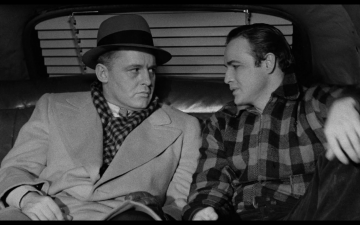 The story and screenplay written by Best Writing winner Budd Schulberg has more memorable lines and quotes than I can enumerate here and should be experienced to fully appreciate the depth of writing.
When superb acting and a great script are coupled with the skillful direction of Best Director winner Elia Kazan and a musical score composed by nominee Leonard Bernstein, the resultant is a film not to be missed. We previously commented on the skillful direction of Elia Kazan in our commentary on Best Picture winner Gentleman’s Agreement (1947). It is difficult to impart the feeling of the Bernstein score – it is both atmospheric and, at times, exciting. Although we have viewed other Oscar winning films that won awards for Best Musical Score, this is the first film that I felt that the music played the role of an additional character. We will hear Bernstein’s stylized musical form taken to yet another level when we watch 1961 winner West Side Story.
I would be remiss not the mention the film’s overall casting. 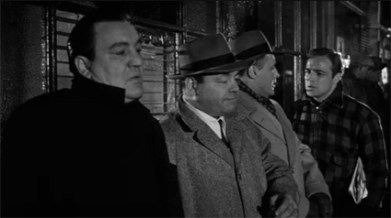 If you had a stereotypical notion of what a 1950’s mobster or a New York longshoreman would look like, On the Waterfront provides the characters. Or is it the film that generated the stereotype? Either way, the physical appearance and clothing of these characters adds to the feel of the film that also won awards for Best Cinematography and Best Art Direction. Bottom line – On the Waterfront is a film that must be seen and if you have seen it before, you should watch it again.
Elliot’s Commentary:
Arguably one of the most iconic films of post-WWII America, On the Waterfront is delivered to audiences with the effective 1,2 punch of Marlon Brando’s dazzling performance and Elia Kazan’s directorial masterpiece. We saw the first glimpse of Elia Kazan’s handiwork in the 1947 best picture winner, Gentleman’s Agreement. While Gentleman’s Agreement contained some of the moralistic messaging of On The Waterfront, the delivery was a little heavy-handed and tone deaf when viewed in a modern context. 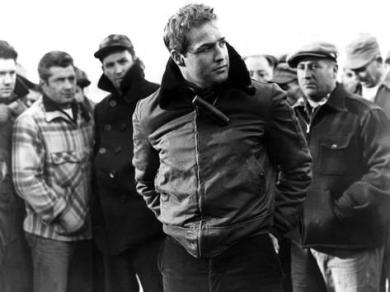 Additionally, both films are slightly tainted in my mind by Kazan’s testimony in front of HUAC in 1952, two years before the release of our current film. On the Waterfront’s depiction of Terry Malloy (Brando), seemingly portrays a justification for Kazan’s testimony in its treatment/veneration of our protagonist’s transformation from mob-adjacent to informant. Despite my serious misgivings with the allegorical nature of the film and its false equivalency in the context of McCarthyism, the art in this case stands alone. This will not be the last time in our journey that we will have to remove external bias in our assessment of the film itself, so as we get to pictures by Woody Allen and Mel Gibson we will again have to note our moral asterisks. For now though, let us not rain on the parade of one of the greatest pieces of acting that we have seen thus far in the form of Marlon Brando’s mastery.
Educated in the Stanislavski system that introduced Hollywood to method acting, Marlon Brando stands alone as a pioneering force that commanded the industry to do better. His emotive, measured acting style showed the power of a masculine entity with emotional range. His first of two Oscars for best actor was rightfully earned for his portrayal of Terry Malloy, an orphaned former boxer trapped between the world he knows and the desire to do the right thing.  Delivering the iconic line, “I could have been a contender” in his dialogue with his brother on their way to Terry’s possible execution, Brando shows his ability to command the screen and catapult this film into the annals of Hollywood history. Brando’s almost dopey and childlike innocence when we are first introduced to him, is disarming as he takes the viewer on a journey of growth, discovery, and ultimate empowerment. His characterization is spellbinding, as we begin to peel back the layers of his character’s psyche. His life as an orphan looking for belonging provides real insight into his journey up until this point. Between his brother, a made man in his own right, and the mob boss Johnny Friendly (Lee J. Cob), Terry is left to face the dubious choice of insider vs. outsider in their world on the docks. It is an impossible choice to turn your back on the life and family you know in order to “do the right thing”, but emboldened by his love interest Edie Doyle (Eva Marie Saint), Terry begins to walk back towards the path of righteousness.
Eva Marie Saint’s performance as Edie Doyle, the sister of a man whose death Terry is an unknowing accomplice in, earned her an academy award for supporting actress. Her beacon of morality in the grim unforgiving waterfront, shows Terry the path of redemption, love, and belonging. 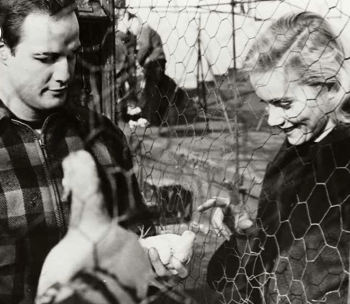 While working on the waterfront, Terry is merely a pawn in the oppressive labor regime, however on the rooftops he shows his compassionate side as the guardian of pigeons in his coop. He trains the pigeons to beware of their natural airborne enemies, the hawks who pray on the weak and defenseless birds. This is clearly an allegory to the effects that the scheming union bosses/enforcers have on the dock workers trying to make a living and feed their impoverished families. Terry is a pigeon and not a hawk, even though his brother and the only life he knows is amongst the hawks. As Terry shows his compassionate side to Edie through his kindness to the pigeons, they solidify their bond to protect the other dockworkers (pigeons) through standing up to the hawks (labor leaders) and ultimately make the waterfront a safer working environment free from undue oversight and corruption.
Overall, On the Waterfront excels at creating the stark environment 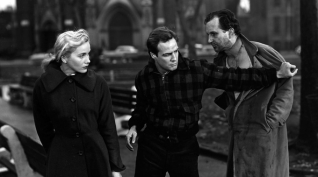 that becomes its own character in the story. Using sound effects to show discord in scenes through devices such as horns and sirens, Kazan is able to punctuate emotional fraught scenes with their own cadences and feeling. These sound effects and score provided by 20th century master, Leornard Bernstein, add depth and nuisance to our film. Through the soundtrack and terrific performances steered by our leading actors, not to mention the emotional and compelling moral compass provided by Father Berry (Karl Malden), the film shows how the line between good and bad can so easily be blurred and the importance of trusting yourself to do what’s right. If the casting of this film was not done as perfectly the story could have ended up landing a bit hollow, however the authenticity of the
 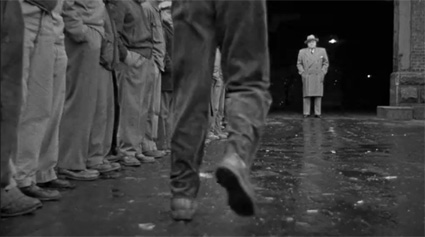 performances remove any sort of tacit veneer and reveal this complex constructed reality.
I had never seen the film before watching it for this review, and I was delighted with my experience. This film is truly Hollywood at it’s finest, and is one of the major reasons for this project. The ability to go back and find a film so original and powerful was truly a joy to me, and I highly recommend any film buff to go out and watch this film.
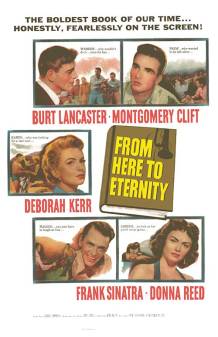
 The
The This stubborn streak continues as Pru refuses to join his new company’s boxing team which leads to a series of cruel menial assignments from guard duty, to digging unnecessary holes, to scrubbing floors, to running laps and mountain trails. He never breaks because of his love of military service which he believes is his life’s work. Montgomery Cliff plays Prewitt convincingly, but I was left wondering what made Prewitt act the way he did. Uneducated orphan, maybe?
 I would have to imagine that From Here to Eternity was considered somewhat shocking in the puritanical 1950’s. Themes involving adultery, consorting with prostitutes (not explicitly stated), pre-marital sex, public drunkenness, and abuse of power by a military officer are not the fare typically seen of films of this era.
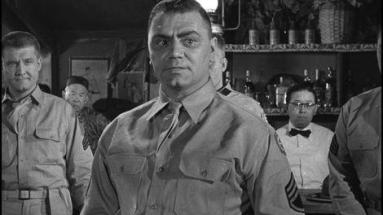 I usually do not enjoy watching characters whose primary role is to portray a drunk. Having recently watched 1946 Best Picture winner
 he novel is much more debaucherous in its depiction of prostitution, however this film was made during the heyday of the
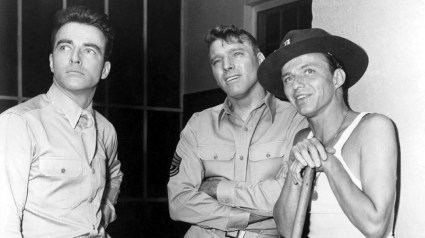
 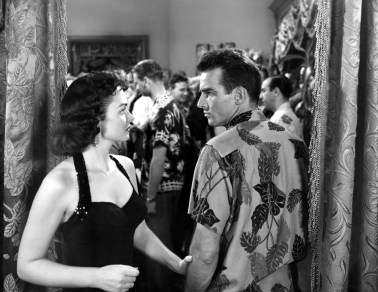 There could not have been a better actor chosen to bring the stubbornness and moxy of Robert E. Lee Pruitt (Pru) to the big screen. While an actor’s off-screen personality and mystique do not always impact their performance, the notoriously private and secluded life of Montgomery Clift fits in perfectly with Pru’s audacity and commitment to his personal morality code. Clift is often lumped into the same category as
 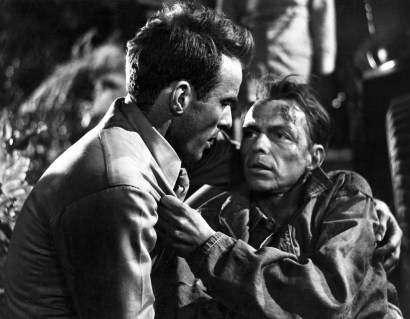 Regardless of the rumors, Frank’s performance was enough to put him back on the map. His comedic timing and brash persona are incredibly captivating, and he rightfully earned the best supporting actor Oscar that he was awarded for the role. His character’s chutzpah in the face of adversity showed off the actor’s incredible range from light-hearted to emotional heart-breaking scenes. Without providing too much of a spoiler for this 50 year-old classic, Maggio’s final scene in the film is one of the most memorable scenes that we have viewed in our journey through film history.
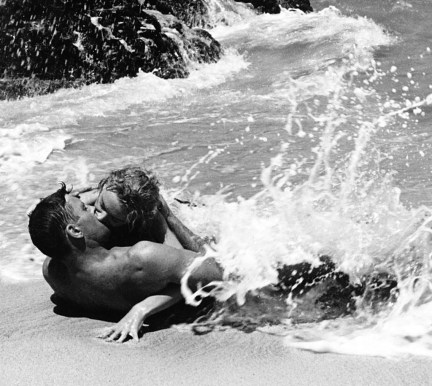
 While the Sergeant does not always take the moral high road, especially in light of his affair with the Captain’s wife, Donna, he still remains a symbol of goodness in the corrupt bureaucratic company. Their scene with the Sergeant and Donna on the beach together is one of the more enduring images from the film and encapsulates the ability of the film to cover all ends of the emotional spectrum.
 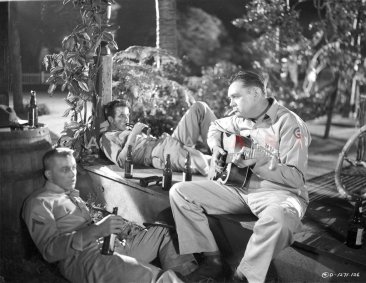 While the film is ultimately a character study with limited discussion of the global conflict of WWII, as the characters’ individual stories begin to resolve themselves, they are faced with “a day that will live in infamy” as FDR described it. The attack on Pearl Harbor makes the stakes of participation in a boxing tournament seem so insignificant, but that is the stark contrast we are faced with.
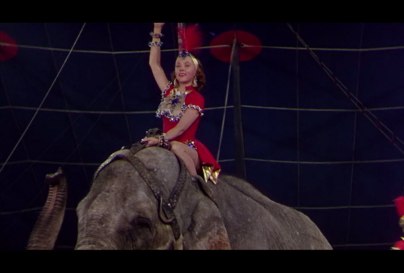
 The movie felt more like a documentary of circus life than the engaging drama which it tried to be. The color cinematography and costuming were well done but the cast of established actors could not salvage the weak storyline.
 My second theory is that a very strong group of competing films split the voting enabling a lesser film to emerge victorious. This list of films includes four motion pictures that are considered classics and I believe are far superior to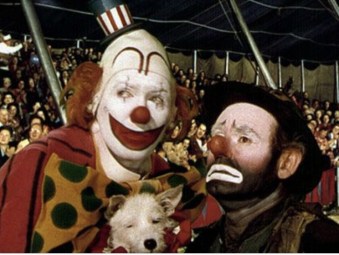
 The foil to Heston’s character is Holly (
 He only had so much to work with given how cheesy the script and storyline were. Also appearing in minor roles were
 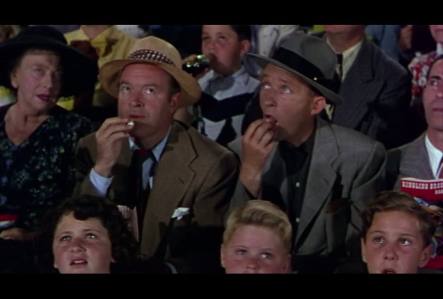 The film also provides behind-the-scenes coverage of moments that the average circus-goer would never get to see such as the circus train, the rigging and set-up of the iconic circus tent, and the practice routines for the various acts as they prepare for the night’s performance. Even moments where Charlton Heston is going through a line-up of elephants and prescribing remedies for elephant-illness such as gin and ginger, are intriguing glimpses of a different world not often glimpsed by the public. As I watched some of the more harrowing trapeze stunts, I found myself on the edge of my seat hoping that we wouldn’t see an accident. When it comes to world building Cecil B. Demille excels at bringing the grandeur of the circus to life, and depicting the magical place of wonderment and danger that delights adults and children alike.
  of blackface and jokes at the expense of the obese and dwarves that are not endearing in a modern context. While I don’t have moral qualms with the concept of the circus in general, there have always been questions about the treatment of animals in the production of these spectacles. Even the the 2017
  Not all of the best picture winners deserve to be remembered in perpetuity, and this film in particular is deserving of its place near the bottom of all best picture winners. Due to the time period, this film was produced during the heyday of the Hollywood Blacklist and McCarthyism and thus we are left with the result of what happens when Hollywood plays it safe. This commercial for the circus was successful in making me want to see a Cirque du Soleil show in the near future, but not much else. See it if you want to laugh at some bad acting, or if you really like dated portrayals of trapeze acts.
 The Kindler Oscar Chronicles