Director: Elia Kazan
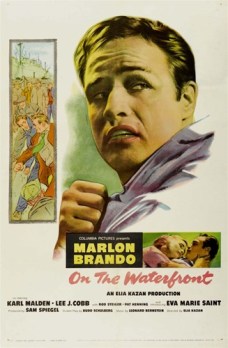
Alex – 8.7 Elliot – 8.8 IMDB 8.3 Rotten Tomatoes 9.2
Alex’s Commentary:
I love On the Waterfront. It is a compelling film from the opening minutes of a person being tossed off a building rooftop, to the climatic march of the longshoremen into a warehouse at the movie’s end. In between, we learn of the mob’s control of union activities on the New York docks, the fear and helplessness of the workers to effectuate change, and the courage of one man, Terry Malloy (Marlon Brando), the former prize-fighter turned longshoreman, and a priest, Father Barry (Karl Malden), to fight against the corruption. 
Terry Malloy is an intriguing character. He is a product of his environment. A boy orphaned young, he and his brother Charley (Rod Steiger) grew up on the streets but took different paths. Charley was the smart one who used his intellect to rise in the mob hierarchy whereas Terry became a boxer and whatever brains he may have had, seemed to have diminished from his time in the ring. Marlon Brando deservingly won the Best Actor award for his convincing portrayal of the tough guy struggling to know right from wrong and ultimately choosing right. His enlightenment develops as the events in the film unfold prompted by the direction of Father Barry and love interest Edie Doyle played by Eva Marie Saint who won Best Supporting Actress. Of course, Edie’s brother is the person tossed off the roof and Terry feels some culpability for this unfortunate event.
Many of the film’s characters have depth and nuance as evidenced by three actors being nominated for Best Supporting Actor, Karl Malden, Rod Steiger, and Lee J. Cobb who plays mob boss Johnny Friendly. One of the movie’s more famous scenes involves brothers Terry and Charley riding in a cab to what could be Terry’s demise for turning against the mob. Terry explains to Charley that “I coulda had class. I coulda been a contender”. 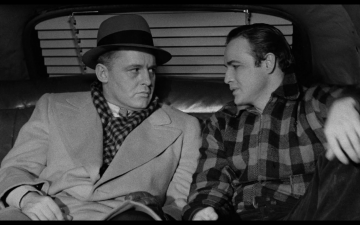 The story and screenplay written by Best Writing winner Budd Schulberg has more memorable lines and quotes than I can enumerate here and should be experienced to fully appreciate the depth of writing.
When superb acting and a great script are coupled with the skillful direction of Best Director winner Elia Kazan and a musical score composed by nominee Leonard Bernstein, the resultant is a film not to be missed. We previously commented on the skillful direction of Elia Kazan in our commentary on Best Picture winner Gentleman’s Agreement (1947). It is difficult to impart the feeling of the Bernstein score – it is both atmospheric and, at times, exciting. Although we have viewed other Oscar winning films that won awards for Best Musical Score, this is the first film that I felt that the music played the role of an additional character. We will hear Bernstein’s stylized musical form taken to yet another level when we watch 1961 winner West Side Story.
I would be remiss not the mention the film’s overall casting. 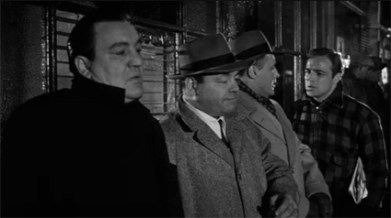 If you had a stereotypical notion of what a 1950’s mobster or a New York longshoreman would look like, On the Waterfront provides the characters. Or is it the film that generated the stereotype? Either way, the physical appearance and clothing of these characters adds to the feel of the film that also won awards for Best Cinematography and Best Art Direction. Bottom line – On the Waterfront is a film that must be seen and if you have seen it before, you should watch it again.
Elliot’s Commentary:
Arguably one of the most iconic films of post-WWII America, On the Waterfront is delivered to audiences with the effective 1,2 punch of Marlon Brando’s dazzling performance and Elia Kazan’s directorial masterpiece. We saw the first glimpse of Elia Kazan’s handiwork in the 1947 best picture winner, Gentleman’s Agreement. While Gentleman’s Agreement contained some of the moralistic messaging of On The Waterfront, the delivery was a little heavy-handed and tone deaf when viewed in a modern context. 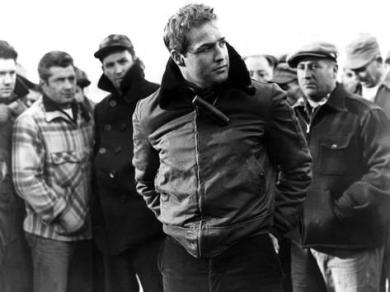 Additionally, both films are slightly tainted in my mind by Kazan’s testimony in front of HUAC in 1952, two years before the release of our current film. On the Waterfront’s depiction of Terry Malloy (Brando), seemingly portrays a justification for Kazan’s testimony in its treatment/veneration of our protagonist’s transformation from mob-adjacent to informant. Despite my serious misgivings with the allegorical nature of the film and its false equivalency in the context of McCarthyism, the art in this case stands alone. This will not be the last time in our journey that we will have to remove external bias in our assessment of the film itself, so as we get to pictures by Woody Allen and Mel Gibson we will again have to note our moral asterisks. For now though, let us not rain on the parade of one of the greatest pieces of acting that we have seen thus far in the form of Marlon Brando’s mastery.
Educated in the Stanislavski system that introduced Hollywood to method acting, Marlon Brando stands alone as a pioneering force that commanded the industry to do better. His emotive, measured acting style showed the power of a masculine entity with emotional range. His first of two Oscars for best actor was rightfully earned for his portrayal of Terry Malloy, an orphaned former boxer trapped between the world he knows and the desire to do the right thing.  Delivering the iconic line, “I could have been a contender” in his dialogue with his brother on their way to Terry’s possible execution, Brando shows his ability to command the screen and catapult this film into the annals of Hollywood history. Brando’s almost dopey and childlike innocence when we are first introduced to him, is disarming as he takes the viewer on a journey of growth, discovery, and ultimate empowerment. His characterization is spellbinding, as we begin to peel back the layers of his character’s psyche. His life as an orphan looking for belonging provides real insight into his journey up until this point. Between his brother, a made man in his own right, and the mob boss Johnny Friendly (Lee J. Cob), Terry is left to face the dubious choice of insider vs. outsider in their world on the docks. It is an impossible choice to turn your back on the life and family you know in order to “do the right thing”, but emboldened by his love interest Edie Doyle (Eva Marie Saint), Terry begins to walk back towards the path of righteousness.
Eva Marie Saint’s performance as Edie Doyle, the sister of a man whose death Terry is an unknowing accomplice in, earned her an academy award for supporting actress. Her beacon of morality in the grim unforgiving waterfront, shows Terry the path of redemption, love, and belonging. 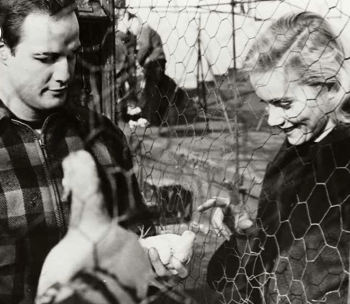 While working on the waterfront, Terry is merely a pawn in the oppressive labor regime, however on the rooftops he shows his compassionate side as the guardian of pigeons in his coop. He trains the pigeons to beware of their natural airborne enemies, the hawks who pray on the weak and defenseless birds. This is clearly an allegory to the effects that the scheming union bosses/enforcers have on the dock workers trying to make a living and feed their impoverished families. Terry is a pigeon and not a hawk, even though his brother and the only life he knows is amongst the hawks. As Terry shows his compassionate side to Edie through his kindness to the pigeons, they solidify their bond to protect the other dockworkers (pigeons) through standing up to the hawks (labor leaders) and ultimately make the waterfront a safer working environment free from undue oversight and corruption.
Overall, On the Waterfront excels at creating the stark environment 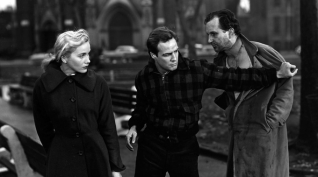 that becomes its own character in the story. Using sound effects to show discord in scenes through devices such as horns and sirens, Kazan is able to punctuate emotional fraught scenes with their own cadences and feeling. These sound effects and score provided by 20th century master, Leornard Bernstein, add depth and nuisance to our film. Through the soundtrack and terrific performances steered by our leading actors, not to mention the emotional and compelling moral compass provided by Father Berry (Karl Malden), the film shows how the line between good and bad can so easily be blurred and the importance of trusting yourself to do what’s right. If the casting of this film was not done as perfectly the story could have ended up landing a bit hollow, however the authenticity of the
 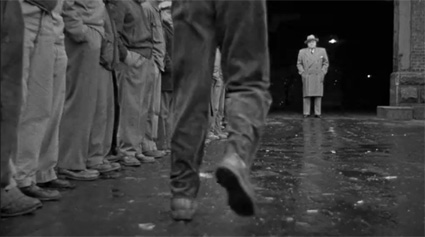 performances remove any sort of tacit veneer and reveal this complex constructed reality.
I had never seen the film before watching it for this review, and I was delighted with my experience. This film is truly Hollywood at it’s finest, and is one of the major reasons for this project. The ability to go back and find a film so original and powerful was truly a joy to me, and I highly recommend any film buff to go out and watch this film.

 There are also unanswered questions such as what happened to the heiress/art patron, Milo Roberts (played by
 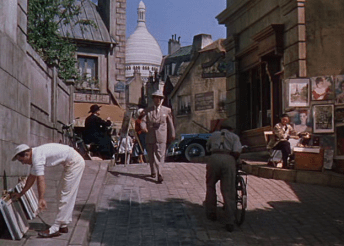 The film was produced in MGM Technicolor which director
  and obviously classically trained. She was also unbelievably flexible!! I would be remiss not to mention
  Minnelli is a legend in the movie musical community, and his work on film classics like
  Without getting too scientific, the
  Vincente Minnelli’s success with Meet Me in St. Louis helped him secure the authorization for the use of Technicolor for the production of An American in Paris. Additionally, based on Minnelli’s stylistic choices, the film would not have been as visually spectacular if the technique was not utilized.
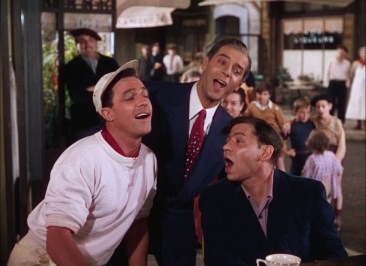 there is a clear narrative structure in the composition that is exciting and interesting even to my untrained ear. George was not the only Gershwin who lent his with musical talents to Hollywood for this film, George’s brother,
 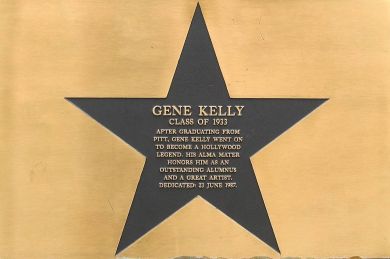 real talent shines through his dancing ability. Kelly not only danced in An American in Paris, but as was the case in all his movie musicals, he choreographed all his dance numbers and assisted on many of the other numbers throughout the film. Gene Kelly was also fluent in French and his linguistic skills are reflected throughout the film.
 Kelly’s character, Jerry Mulligan, is a hero to many of the kid’s in his neighborhood in Paris, making friends by bribing them with bubble gum. His first solo number in the movie, “I Got Rhythm” is one of the big hits of the film and my personal favorite. His singing is sweet and effortless, but the tap number he breaks into halfway through the song is really what takes the viewers breath away.
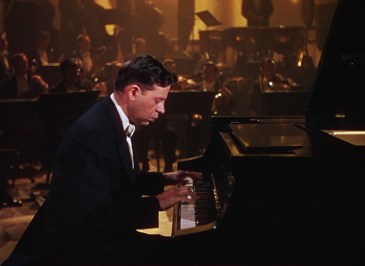 Minnelli takes an interesting stylistic choice to show the actor playing Adam Cook, Oscar Levant, play every member of an entire symphony for a momentous instrumental number. The visually stunning scene coupled with its bombastic score is one of the strongest moments of the film.
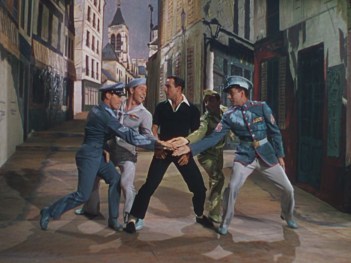 abstract set with an intentionally disorienting dance number, reemphasizes the strength of this film. The sensational finale with an almost uninterrupted 17-minute dance number is incredible. The set design takes us from painting to painting, with each successive scene taking the audience from loss, to hope, to happiness as the story is resolved abstractly in bright colorful mood-indicative lighting. While we do have a joyful embrace as Jerry and Lise end up together, it almost seems superfluous after the phenomenal dance number that is one of the most spectacular that I have ever seen in film.
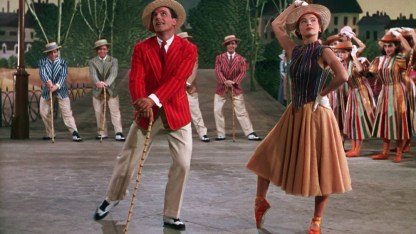 I can’t help but be charmed by watching Gene Kelly tap dance, and the closing number combining men tap-dancing with women led by Leslie Caron dancing on point is truly amazing. It’s hard to compare the cerebral and psychological All About Eve which won last year, with this film which thrives on its visual stimulation. Honestly, I would have preferred
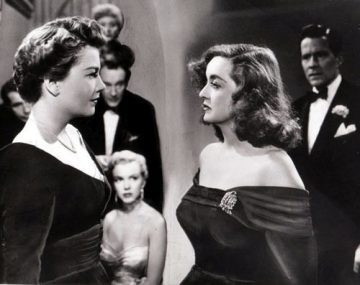
 (Best Supporting Actress from
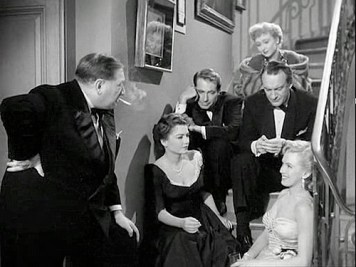
 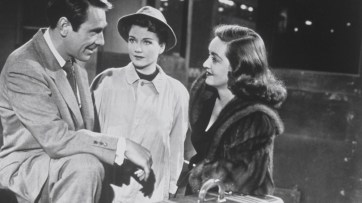 the kindly wife of the playwright, Karen Richards (Celeste Holm), and leads to Mrs. Richards introducing Eve to her close friend Margo Channing. At this chance encounter, we meet the rest of the morose group of faces in the actresses changing room: Actress Margo Channing, Playwright Lloyd Richards (Richard Marlowe), and Margo’s boyfriend director Bill Sampson (Garry Merrill). The meeting gives Eve the first opportunity to act as she uses her sob story of growing up poor, losing her husband in WWII, and theater and fandom as her one true escape from her life’s woes, to encapsulate the attention of the group. Eve Harrington’s story in particular charms Margo through her naivete and flattery, and soon becomes a tenant in the actress’ life. Within a day, Margo has moved Eve into her flat in New York and put her to work as an assistant, accountant, and friend/companion.
 Additionally, as multiple pretty young actresses vie for parts with several of the older producers, directors, and playwrights present at the party, Margo is left feeling old and out of demand by the new crop of competition. Davis’ portrayal of Margo in this moment is vivid and brilliant, and very well informed by her status in the industry 10 years after her Oscar-winning prime. As the party continues into the night, Margo filled with many very dry martinis is left at one of her most vulnerable. This is also the moment in the film, Eve uses her new standing in the theater society to ask the playwright’s wife, Karen Richards, for the opportunity to serve as understudy in Margo’s long-running play since Eve has seen every production.
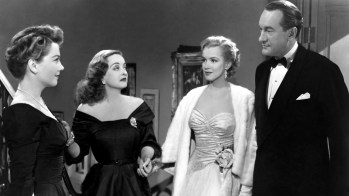 unhappy rabbits?” To which her companion the director, Addison DeWitt, replies “Now go make him a happy”. This sexual innuendo certainly hints at something more than just a friendly conversation, and Fabian’s appearance looks eerily similar to Harvey Weinstein. While the film doesn’t quite escalate the conversation to the #MeToo movement of today’s Hollywood landscape, the intimation of the metaphorical casting couch is quite scandalous in the post
  The car’s depletion of gas limited its ability to make Margo’s train back to New York on time, and gave Eve the break she needed as she gave an entire play’s performance to a group of newspaper critics. Not only does Margo’s absence allow Eve an opportunity to shine in front of critics, but it also is the opportunity Eve uses to make a pass at Margo’s boyfriend, Bill Sampson.
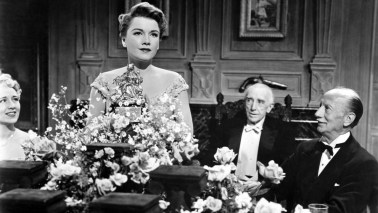 She maneuvers her way into Lloyd Richards’ new play in a part originally intended for Margo. This gamesmanship leads us to the fateful night where Eve stands before her group of “friends” to accept the award for his stolen role and part.
 The Kindler Oscar Chronicles