Director: Joseph L. Mankiewicz

Alex – 8.0 Elliot – 8.5 IMDB 7.5 Rotten Tomatoes 7.9
Alex’s Commentary
In our last movie, All the King’s Men, we saw that a person can be blinded by political ambition. In All About Eve, we see that an actress can also be blinded by ambition. Eve Harrington (Anne Baxter) idolizes stage star, Margo Channing (Bette Davis), and plots to steal her role in a future Broadway production. The film is an interesting character study combined with an element of mystery – who really is Eve Harrington and what are her plans to achieve her goals? Who will she deceive and lie to in her quest? Both Ms. Baxter and Ms. Davis were nominated for Best Actress in a Leading Role and may have split the vote. This resulted in a win for Judy Holliday for her performance in Born Yesterday, a play which I had a minor role in high school!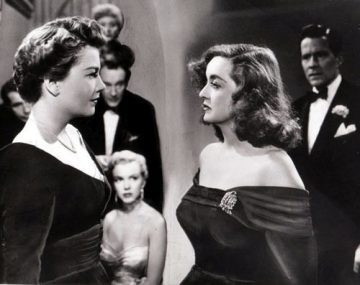
Joseph L. Mankiewicz won both Best Director and Best Writing, Screenplay, awards that I feel are well deserved. The script is intelligently written with more literary and theater references than I admit to fully comprehend, although the intent of the references is clear.
The strong cast includes George Sanders (Best Supporting Actor) who plays Addison DeWitt, a theater critic who wields power and influence and is despised by the theater community who are afraid not to include him in their activities for fear of reprisal. Other standout performances are given Celeste Holm (Margo’s best friend Karen) and Thelma Ritter (Margo’s dresser/secretary Birdie until Eve usurps her position).
As one would expect in a film portraying the Broadway elite, the costuming is excellent and yielded Edith Head one of her eight Oscars for Best Costume Design. Nominated for record 14 awards at the 23rd Academy Awards (tied with Titanic (1997) and La La Land (2016)), the movie is enjoyable by those who like witty, fast-paced dialogue combined with backstage backstabbing and a few unexpected plot twists.
Elliot’s Commentary:
Based on the short story, “”The Wisdom of Eve”, written by Mary Orr , chronicles the story of a young super-fan’s immersion into a circle of theater friends. Produced in 1950, All About Eve is our first film of the new decade. The beginning of the proto-typical 1950’s suburban lives has become a reality across the country. The threat of communism is spreading and the Korean War had started in June based on the China and Soviet-backed invasion of South Korea by the Northern communist regime. The start of the conflict in Korea marks the first escalation of the Cold War following the power-struggle between the US, China, and the Soviet Union in the aftermath of WWII. It was also during 1950, that the Red Channels pamphlet was published outing prominent members of the television, film, and radio committee as communist sympathizers. Notable names listed in the pamphlet included Orson Welles, Leonard Bernstein, Arthur Miller, Lena Horne, Edward R. Murrow and Artie Shaw. During this time, Hollywood pivoted from some of the more controversial subjects like antisemitism covered in Gentleman’s Agreement just a few years earlier, and played it safer with subjects relating even indirectly to controversial political topics. While there was a dark haze hanging both over Hollywood as well as the Kangaroo court of the House Un-American Activities Commission (HUAC), All About Eve emerged as the best film to win an Academy Award for Best Picture since 1943’s Casablanca.
Joseph L. Mankiewicz won two Oscars for his directing and screenplay for his work on the film. The screenplay is certainly deserving of the Oscar with some of the best dialogue that we’ve had in a movie thus far. Bolstered by the amazing two-time Oscar winner Bette Davis (Jezebel and Dangerous), the star-studded cast brings Joseph L Mankewicz’s script to life. Davis is joined in the film by Celeste Holm 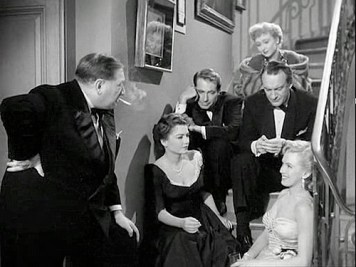 (Best Supporting Actress from Gentleman’s Agreement), Hugh Marlowe, Anne Baxter, George Sanders (Best Supporting Actor win for All About Eve for his portrayal of play director Addison DeWitt and supporting character, Jack Favell, in the 1940 best picture winner, Rebecca) and a very young unknown star at the time named Marilyn Monroe. The film also marked Bette Davis’ comeback after a series of lackluster films at the end of her 18 year tenure at Warner Brothers.
While the film starts with Anne Baxter’s character, Eve, winning a significant theater prize, the film clearly shows the faces of a group of solemn faces gazing at the actress winning the award with a certain morose and dumbstruck expression. Through flashback, we are taken to the group’s first encounter with Eve as a superfan who watches every single one of idol, Margo Channing’s (Bette Davis) performances from the standing room section of a theater in New York. This dedication catches the attention of 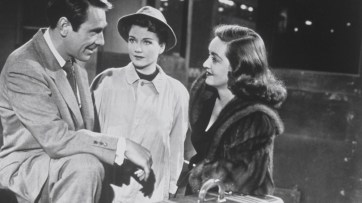 the kindly wife of the playwright, Karen Richards (Celeste Holm), and leads to Mrs. Richards introducing Eve to her close friend Margo Channing. At this chance encounter, we meet the rest of the morose group of faces in the actresses changing room: Actress Margo Channing, Playwright Lloyd Richards (Richard Marlowe), and Margo’s boyfriend director Bill Sampson (Garry Merrill). The meeting gives Eve the first opportunity to act as she uses her sob story of growing up poor, losing her husband in WWII, and theater and fandom as her one true escape from her life’s woes, to encapsulate the attention of the group. Eve Harrington’s story in particular charms Margo through her naivete and flattery, and soon becomes a tenant in the actress’ life. Within a day, Margo has moved Eve into her flat in New York and put her to work as an assistant, accountant, and friend/companion.
While there is some foreshadowing, with Eve trying on Margo’s dress from the play, the transformation from doting assistant to conniving and plotting understudy is pronounced but slow. Eve’s move to throw a birthday party for Margo’s boyfriend, Bill Sampson, marks her first deliberate move to interfere in Margo’s affairs. The party plays on several of Margo’s insecurities such as a pretty young woman encroaching on her territory with her younger boyfriend, Bill.  Additionally, as multiple pretty young actresses vie for parts with several of the older producers, directors, and playwrights present at the party, Margo is left feeling old and out of demand by the new crop of competition. Davis’ portrayal of Margo in this moment is vivid and brilliant, and very well informed by her status in the industry 10 years after her Oscar-winning prime. As the party continues into the night, Margo filled with many very dry martinis is left at one of her most vulnerable. This is also the moment in the film, Eve uses her new standing in the theater society to ask the playwright’s wife, Karen Richards, for the opportunity to serve as understudy in Margo’s long-running play since Eve has seen every production.
The film’s commentary on celebrity, fandom, envy, and even ageism in Hollywood/the stage, is biting and relevant even in today’s climate. Marilyn Monroe’s character, Miss Caswell arrives at a party and is sent to entertain a portly producer, Max Fabian portrayed by Gregory Rattoff with this biting line “Why must all producers look like 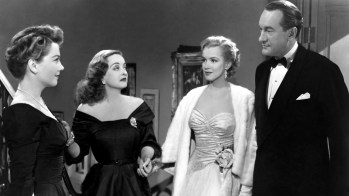 unhappy rabbits?” To which her companion the director, Addison DeWitt, replies “Now go make him a happy”. This sexual innuendo certainly hints at something more than just a friendly conversation, and Fabian’s appearance looks eerily similar to Harvey Weinstein. While the film doesn’t quite escalate the conversation to the #MeToo movement of today’s Hollywood landscape, the intimation of the metaphorical casting couch is quite scandalous in the post motion picture production code of that era of Hollywood.
Cut to a week after the party and not only has Eve received the role of understudy in Margo’s play, but she has also hidden her new role from Margo until a matinee in which our lead actress was unable to attend. Eve’s performance of one scene garnered great reviews and caused Margo to go into a slight frenzy after realizing that her part in the play, which was written for a 24 year old, might better suit Eve than our aging starlet. The shift is truly solidified by a “prank” that Karen plays on Margo where she drained the gasoline tank of a car on the return from a trip to the countryside.  The car’s depletion of gas limited its ability to make Margo’s train back to New York on time, and gave Eve the break she needed as she gave an entire play’s performance to a group of newspaper critics. Not only does Margo’s absence allow Eve an opportunity to shine in front of critics, but it also is the opportunity Eve uses to make a pass at Margo’s boyfriend, Bill Sampson.
Bill fortunately turns down Eve’s advance, but this scene is viewed by critic Addison DeWitt (George Sanders) who uses Eve’s vulnerability for a date and perhaps more. Addison posts a glowing review of Eve’s performance while disparaging Margo’s age and ability to play the part. It is in this scene as well, Addison digs deeper into Eve’s tale and begins to reveal doubt on her sob story that so enchanted the original group in the changing room. As Eve’s veneer begins to fade, and we see her true Machiavellian nature she begins to come from the shadows and act more forcefully to get what she wants. 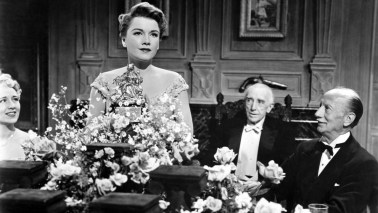 She maneuvers her way into Lloyd Richards’ new play in a part originally intended for Margo. This gamesmanship leads us to the fateful night where Eve stands before her group of “friends” to accept the award for his stolen role and part.
Overall the film touches on a myriad of tropes that are as timeless as this film, sexism, ageism, fandom, and the perpetual search for celebrity. This film inspired even more sinister movies with similar plots of obsession and becoming the object of your obsession such as The Talented Mr. Ripley, Single White Female, Black Swan and many more. The screenplay of this movie was truly a work of art and the snappy and engaging dialogue is as timeless as the brilliant performances. Of the films we have viewed throughout our journey, this was the first one that I had never seen to truly blow me away. It is a classic in every right and a true masterpiece of 1950’s cinema. If you have not had the pleasure of viewing this film, please spend the time to become acquainted with this masterpiece of cinematic achievement.

 Oscar winner for Best Actor, the story follows Willie’s transformation from unsophisticated do-gooder into maniacal leader of a political machine that will stop at nothing to accomplish Willie’s goals – goals which now center on Willie Starks’ personal agenda and far less on his constituency.
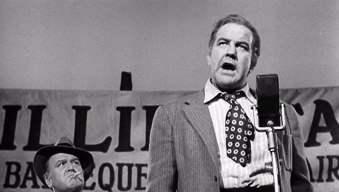 This is Willie’s way of justifying his wrongdoings if, ultimately, it results in a greater good. In other words, it is acceptable to bribe and pay graft if the result is a new hospital or highway. Of course, every highway, hospital, university or museum has the Stark name prominently displayed lest people forget who made it all happen. Interestingly, some of Willie’s campaign promises of free health care, free university education and no farmer losing his land to foreclosure can still be heard on the campaign trail today.
 dubious slide from idealist to hatchet man. Also,
 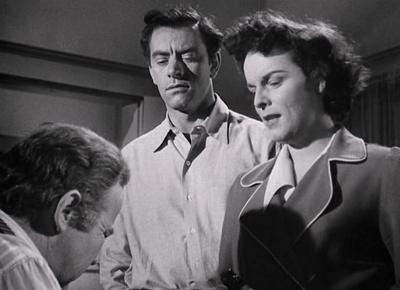 as an honest politician. Willie’s honesty and need to share the truth with the people during his campaigning is met with this biting response: “We all believe in free speech Willie- We got to, it’s in the constitution.” Essentially this quote damns free speech to a necessary evil that is not much appreciated in this small town. We are also given an introduction into his character’s psyche, as a man having adopted the son of a friend who was too poor to support him and one who was victimized by the institution that fired his wife due to his exposure of the corruption of the system. Willie was a cog in the political machine that society ran on, and he aimed to throw a wrench into works and really shake things up from the inside.
 Willie’s speeches made waves in the state capitol, inspiring a political party to back Willie as their representative for the gubernatorial race. Unfortunately, the group backing Willie’s true intentions were to split the vote of the rival candidate and make way for their actual front-runner.
 enter the next stage of the film, Willie is now a hero of the people running four years later for his second attempt at governor. While at first, we are hopeful that he is staying true to the character that we met on the farm all of those years ago, we are greeted now with insinuations that the money financing his new campaign is coming with strings attached -the same types of promises that he criticized in his first campaign for county commissioner. This time, however, Willie won in a landslide and the audience is left with a lingering question, “At what cost?”. Willie offers Jack a job at a rate 25% higher than he was making at the newspaper with the ominous concession, “Money? I don’t need money. People give me things. Because they believe in me”. Jack even brings Willie to his parent’s house, the world that seemed unreachable just a few short years earlier. At this point, through power, Willie is able to breach the socioeconomic divide and win their support albeit with the caveat of continuing to broker deals despite the repercussions. It is at this point in the film where we see the beginning of a pivot from a morality play to a cautionary tale. It’s hard to not continually compare the fictional political landscape portrayed in the movie to our current political landscape in America. Almost seventy years later we are still pursuing the same issues: healthcare, education, tax reform, and the menace of political corruption.
 In the aftermath, the woman’s father disappears when he refuses a bribe, and then the adopted son is paralyzed in a football accident. After the father’s beaten body appears, impeachment proceedings begin against Willie. Willie uses his popularity with the people for his own gain by convincing them that the news and media were lying and that he was telling them the truth. This type of gaslighting to bend the will of the people has clear parables to other current events today.
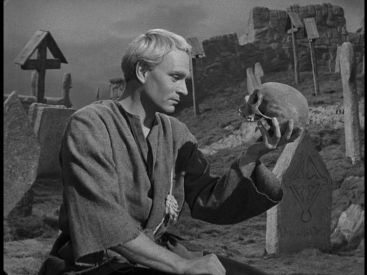 However, I don’t believe this would unique enough to qualify for best picture.
  Hamlet is also the first film that we have reviewed where the director was also the leading actor in the film. While Olivier did not win the directing award, his achievement of directing a best picture where he also won best actor clearly solidifies his place in the annuls of Oscar history.
 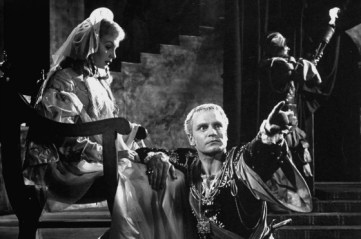 The acting is superb at parts, but does show flourishes of melodrama typical of earlier films. Additionally, the sometimes dragging moments are disrupted by the hits of the Shakespearean dialogue with a performance of the “To Be or Not to Be” Monologue delivered with Olivier’s incredible acting chops. Besides Olivier, the real star of this film is the soundtrack. Between the brilliant score played by the orchestra, the sound effects in the form of heartbeats and gusty corridors add tremendously to moments of introspection and eeriness.
  The Kindler Oscar Chronicles