Director: Vincente Minnelli

Alex – 7.2 Elliot – 7.5 IMDB 7.2 Rotten Tomatoes 8.0
Alex’s Commentary:
An American in Paris is a musical that shares similar features with many musicals. Often, plot takes a back seat in a film or stage production as it is merely a device to present music and dance. The plot of American in Paris, shows a struggling American artist (Gene Kelly) falling in love with a woman (Leslie Caron) who was to be married to another man (Georges Guétary). This premise is ultimately weak. Not that I don’t believe in love at first sight, but it would seem as though artist Jerry Mulligan proposes to Lise Bouvier after knowing her for less than a week or two.  There are also unanswered questions such as what happened to the heiress/art patron, Milo Roberts (played by Nina Foch), after Jerry leaves her at the big soiree to run off with Lise. Additionally, the film doesn’t show the conversation that occurred in the cab ride between Lise and Henri Baurel to make them return to the party with Henri’s apparent blessing. Of course, with a running time of close to two hours, I didn’t really care that much! Our previous three Best Picture musicals, The Broadway Melody, The Great Ziegfeld, and Going My Way, had much better stories (or at least the last two). It should be noted that Alan Jay Lerner did win an Oscar for Best Writing, Story and Screenplay, so some people must not share my feelings regarding the shortcomings of the story.
With that being said, please don’t be mistake my critiques for a dissuasion for viewing this film. If you are a fan of elaborate production dance numbers, this movie offers a dance extravaganza that I would suspect had not previously been seen on film. I love tap dance numbers and An American in Paris showcases Pittsburgher Gene Kelly at his finest. The movie’s backdrop, Paris just after WWII, is beautiful and interesting particularly as portrayed through an American 1950’s perspective. 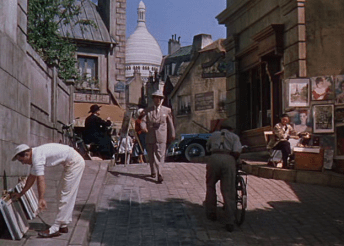 The film was produced in MGM Technicolor which director Vincente Minnelli uses to its fullest with lush Paris street scenes, sidewalk cafes, and a climatic epic colorful dream sequence dance number. This particular dance number, that feels like it could be fifteen minutes or longer in length, combines tap numbers with ballet, modern dance and traditional Broadway show mega-ensemble vignettes. This film also won Academy Awards for Best Cinematography, Best Set Decoration – Color, Best Costume Design and Best Scoring of a Musical Picture. I agree that all of these awards are well deserved.
Most of the songs were written by George and Ira Gershwin in the 1920s and 1930s. It wasn’t clear to me why these songs were chosen for the film as I do not believe they have anything to do with Paris of the late 1940’s. In fact, “‘S Wonderful, S’ Marvelous” first appeared in the 1927 Broadway musical Funny Face. The songs are immediately recognizable, which may have contributed to the film’s success.
French born Leslie Caron makes her film debut in An American in Paris. Probably better known for her future roles in Lili (1953) and Gigi (1958), I did not realize she was such accomplished dancer  and obviously classically trained. She was also unbelievably flexible!! I would be remiss not to mention Oscar Levant as an unemployed piano player/composer. Another fellow Pittsburgher, he has some incredible piano numbers and some memorable one-liners. Oscar was a good friend of George Gershwin and after Gershwin’s death, Levant was considered the preeminent interpreter of Gershwin’s works.
The movie has a line which I found very funny. When Jerry Mulligan is visiting Milo Roberts in her apartment, she appears in a cocktail dress with an exposed shoulder. Jerry asked Milo, “What’s keeping that dress up?” and she replies, “My modesty.” Love that line!
Although the movie does drag at times and feels overly long, I would still recommend it for any viewer who enjoys musicals and Gershwin songs.
Elliot’s Commentary:
With An American in Paris, we take our journey back to the land of the musical. Previously, we have viewed three other musicals: The Broadway Melody, The Great Ziegfeld, and Going My Way. These films all have their own unique traits, but none of them had the cohesion and vision that An American in Paris showed. Additionally, while I do enjoy the grandeur of a Ziegfeld or Busby Berekely production, I appreciate Vincente Minnelli’s direction to establish the setting of this picture in a different environment and provide viewers with a more modern approach to the musical.  Minnelli is a legend in the movie musical community, and his work on film classics like Meet Me in St. Louis (1944) and the soon to be reviewed 1958 Best Picture, Gigi, have cemented his place in film history. His meticulously planned out scenes reflect his past working in the theater as a set designer and costume artist during the great depression. While his direction and work have made quite an impression on the film community, his personal life also intersected with some of the most dynamic stars in Hollywood History. Minelli’s first marriage to an actress he met on the set of Meet Me in St. Louis, Judy Garland, resulted in the birth of his oldest daughter, legend in her own right, Liza Minnelli. While Judy Garland was snubbed twice from her two Oscar nominations, she received an Academy Juvenile Award for her performance in 1939’s The Wizard of Oz. Judy and Vincente’s daughter, Liza Minelli, followed her parents into the movie musical genre and received an Academy Award for Best Actress for her role in Cabaret in 1972. However, unlike Vincente, neither Judy nor Liza ever appeared in a film that garnered the award for Best Picture.
While Vincente was a true auteur in his own right, his stylistic choices are a bit over the top by today’s standards. The mesmerizing use of technicolor in the costumes and scenes presented in vivid light are so bright, many scenes take on a dreamlike quality. This is the second film to win best picture that was presented in its entirety in technicolor, the first being Gone With The Wind. In the 1940’s and 1950’s only a limited number of films were produced using the technicolor technique due to the cost of the production. 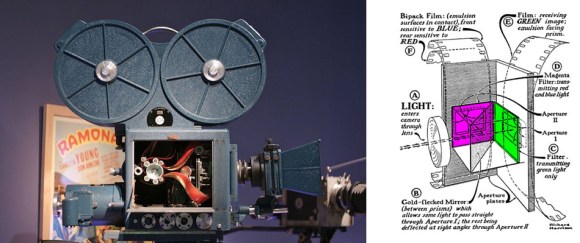 Without getting too scientific, the Digital Intermediate Guide describes the technicolor technique as “Two strips of 35 mm black and white film negative, one sensitive to blue light and the other to red light, ran together through an aperture behind a magenta filter, which allowed blue and red light to pass through. A third film strip of black and white film negative ran through a separate aperture, behind a green filter.” This expensive process made production houses prioritize the use of Technicolor for large, big budget productions that would bolster their ROI’s through the use of this technique. Due to the box office success of movie musicals, these larger productions were often prioritized for the use of Technicolor.
  Vincente Minnelli’s success with Meet Me in St. Louis helped him secure the authorization for the use of Technicolor for the production of An American in Paris. Additionally, based on Minnelli’s stylistic choices, the film would not have been as visually spectacular if the technique was not utilized.
While Minnelli’s spectacular mise-en-scene solidified the visuals in the film, the success of An American in Paris was also driven by the 1928 George Gershwin piece of the same name. Gershwin died 1937, 14 years before the success of An American in Paris, however his achievements in orchestral composition are some of the most influential in the 20th century. Between An American in Paris (1928), Rhapsody in Blue (1924), and Porgy and Bess (1935), Gershwin made a remarkable imprint on the musical landscape of America. If not for his tragic death in 1938, who knows how many other timeless classics would be included in this brief summary of his talents? Before reviewing the film, I listened to the entirety of “Rhapsody in Blue” and “An American in Paris” to provide context for my watching experience. As the score shifts between each musical stanza, 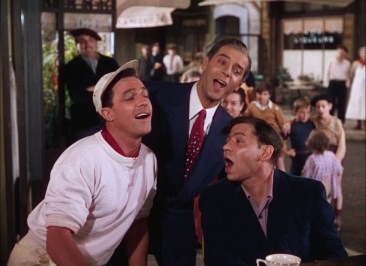 there is a clear narrative structure in the composition that is exciting and interesting even to my untrained ear. George was not the only Gershwin who lent his with musical talents to Hollywood for this film, George’s brother, Ira, wrote the lyrics for all of the songs included in An American in Paris. He also collaborated with his brother to create the lyrics for the opera, Porgy and Bess. Together, the Gershwin brothers produced the perfect musical score to provide the backdrop for Minnelli’s Hollywood production.
An American in Paris stars Gene Kelly with a performance that helped solidify his place in film history. Gene Kelly was born and raised in Pittsburgh, PA and attended the University of Pittsburgh (Where my father and I received our graduate education). While An American in Paris enlists the help of Kelly as a triple threat (Dancing, Singing, and Acting), his 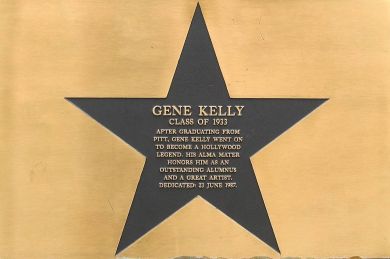 real talent shines through his dancing ability. Kelly not only danced in An American in Paris, but as was the case in all his movie musicals, he choreographed all his dance numbers and assisted on many of the other numbers throughout the film. Gene Kelly was also fluent in French and his linguistic skills are reflected throughout the film.
The movie centers on the story of painter, Jerry Mulligan (Gene Kelly), and his friend concert pianist, Adam Cook (Oscar Levant) as they navigate post-war Paris. The film does a good job navigating between scenes taking place on the streets and restaurants in Paris as well as larger sound stage productions.  Kelly’s character, Jerry Mulligan, is a hero to many of the kid’s in his neighborhood in Paris, making friends by bribing them with bubble gum. His first solo number in the movie, “I Got Rhythm” is one of the big hits of the film and my personal favorite. His singing is sweet and effortless, but the tap number he breaks into halfway through the song is really what takes the viewers breath away.
French Singer Henri Baurel (Georges Guétary) and his girlfriend and Lise Bouvier (Leslie Caron) become interwoven in the plot as Adam Cook introduces Jerry to Henri at a coffee shop. They have a great number where Henri describes his new girlfriend Lise to Adam. Although Lise doesn’t appear in the scene in actuality, they show a cut-away with a very stylized monochromatic dance number in a variety of different scenes and different colors corresponding to the attributes being described. Leslie Caron is an incredibly graceful dancer and the scene showcases her tremendous talents. Jerry and Lise’s paths cross later in the picture without the context of Henri’s presence to distract, and there emerges a love-triangle between Lise, Henri, and Jerry. While the love triangle is unfolding, there is a great interstitial number starring the pianist Adam Cook. 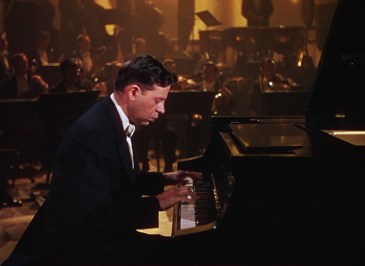 Minnelli takes an interesting stylistic choice to show the actor playing Adam Cook, Oscar Levant, play every member of an entire symphony for a momentous instrumental number. The visually stunning scene coupled with its bombastic score is one of the strongest moments of the film.
As with most typical comedies with love triangles, there is a certain dramatic irony conveyed in the film. As the two men, Henri and Jerry give each other advice about how to handle relationship difficulties with the same woman. The conflict is quickly deflated after Lise reveals to Jerry that she is engaged to be married to Henri. This revelation forces Jerry into the arms of a wealthy benefactor who has been bankrolling his art career, Milo Roberts (Nina Foch). While this distraction did not improve Jerry’s general disposition, the sadness and mania conveyed in a French-colored (Red, White, and Blue) 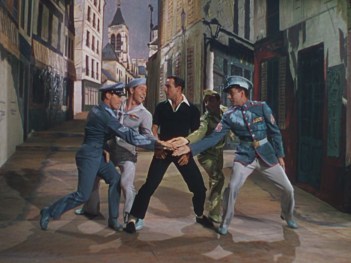 abstract set with an intentionally disorienting dance number, reemphasizes the strength of this film. The sensational finale with an almost uninterrupted 17-minute dance number is incredible. The set design takes us from painting to painting, with each successive scene taking the audience from loss, to hope, to happiness as the story is resolved abstractly in bright colorful mood-indicative lighting. While we do have a joyful embrace as Jerry and Lise end up together, it almost seems superfluous after the phenomenal dance number that is one of the most spectacular that I have ever seen in film.
An American in Paris is not a perfect film by any stretch of the imagination, but it is stylistically distinct and significant with true flashes of brilliance through song and dance. Gene Kelly and Leslie Caron are sensational in this picture and Minnelli is able to frame scenes in a visually-stunning fashion that creates a true delight for the senses. The plot is a bit pedestrian and not terribly interesting or well-developed, but with many musicals that is an aspect that can be overlooked since ultimately, they are merely a vehicle by which to orient the musical numbers. While there was only one true song that dazzled me lyrically (“I’ve Got Rhythm”), the musical score and dancing in this film were truly captivating and beautiful. 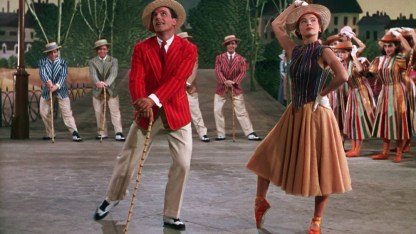 I can’t help but be charmed by watching Gene Kelly tap dance, and the closing number combining men tap-dancing with women led by Leslie Caron dancing on point is truly amazing. It’s hard to compare the cerebral and psychological All About Eve which won last year, with this film which thrives on its visual stimulation. Honestly, I would have preferred A Streetcar Named Desire as this year’s Oscar winner but that is not to say that this film was without merit. In fact, the argument that An American in Paris did more for film makes sense due to the innovation in set-design, cinematography, choreography, and production that this film conveyed. It has been my favorite of the four musicals that we have seen thus far, but in general I prefer the more lyrical Rodgers and Hammerstein style of musical.

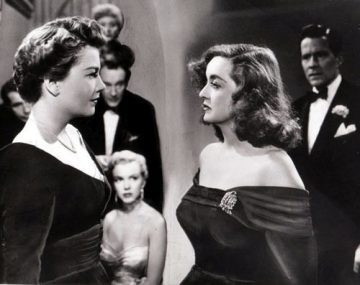
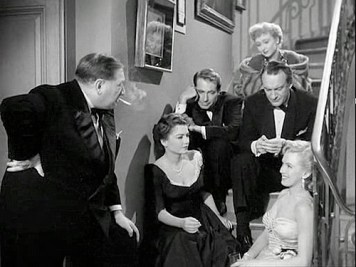 (Best Supporting Actress from
 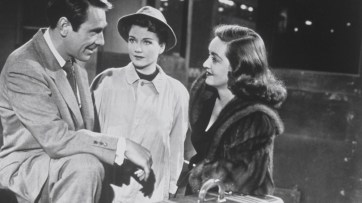 the kindly wife of the playwright, Karen Richards (Celeste Holm), and leads to Mrs. Richards introducing Eve to her close friend Margo Channing. At this chance encounter, we meet the rest of the morose group of faces in the actresses changing room: Actress Margo Channing, Playwright Lloyd Richards (Richard Marlowe), and Margo’s boyfriend director Bill Sampson (Garry Merrill). The meeting gives Eve the first opportunity to act as she uses her sob story of growing up poor, losing her husband in WWII, and theater and fandom as her one true escape from her life’s woes, to encapsulate the attention of the group. Eve Harrington’s story in particular charms Margo through her naivete and flattery, and soon becomes a tenant in the actress’ life. Within a day, Margo has moved Eve into her flat in New York and put her to work as an assistant, accountant, and friend/companion.
 Additionally, as multiple pretty young actresses vie for parts with several of the older producers, directors, and playwrights present at the party, Margo is left feeling old and out of demand by the new crop of competition. Davis’ portrayal of Margo in this moment is vivid and brilliant, and very well informed by her status in the industry 10 years after her Oscar-winning prime. As the party continues into the night, Margo filled with many very dry martinis is left at one of her most vulnerable. This is also the moment in the film, Eve uses her new standing in the theater society to ask the playwright’s wife, Karen Richards, for the opportunity to serve as understudy in Margo’s long-running play since Eve has seen every production.
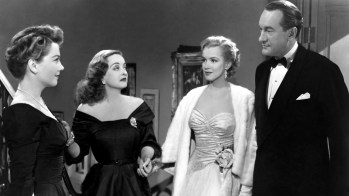 unhappy rabbits?” To which her companion the director, Addison DeWitt, replies “Now go make him a happy”. This sexual innuendo certainly hints at something more than just a friendly conversation, and Fabian’s appearance looks eerily similar to Harvey Weinstein. While the film doesn’t quite escalate the conversation to the #MeToo movement of today’s Hollywood landscape, the intimation of the metaphorical casting couch is quite scandalous in the post
  The car’s depletion of gas limited its ability to make Margo’s train back to New York on time, and gave Eve the break she needed as she gave an entire play’s performance to a group of newspaper critics. Not only does Margo’s absence allow Eve an opportunity to shine in front of critics, but it also is the opportunity Eve uses to make a pass at Margo’s boyfriend, Bill Sampson.
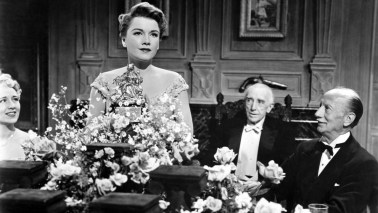 She maneuvers her way into Lloyd Richards’ new play in a part originally intended for Margo. This gamesmanship leads us to the fateful night where Eve stands before her group of “friends” to accept the award for his stolen role and part.
 Oscar winner for Best Actor, the story follows Willie’s transformation from unsophisticated do-gooder into maniacal leader of a political machine that will stop at nothing to accomplish Willie’s goals – goals which now center on Willie Starks’ personal agenda and far less on his constituency.
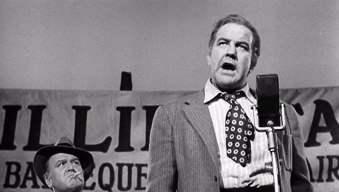 This is Willie’s way of justifying his wrongdoings if, ultimately, it results in a greater good. In other words, it is acceptable to bribe and pay graft if the result is a new hospital or highway. Of course, every highway, hospital, university or museum has the Stark name prominently displayed lest people forget who made it all happen. Interestingly, some of Willie’s campaign promises of free health care, free university education and no farmer losing his land to foreclosure can still be heard on the campaign trail today.
 dubious slide from idealist to hatchet man. Also,
 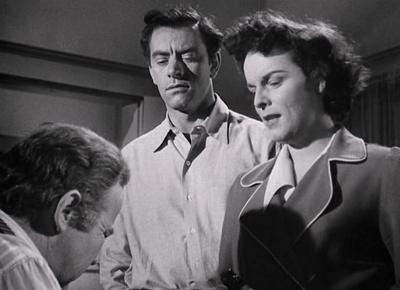 as an honest politician. Willie’s honesty and need to share the truth with the people during his campaigning is met with this biting response: “We all believe in free speech Willie- We got to, it’s in the constitution.” Essentially this quote damns free speech to a necessary evil that is not much appreciated in this small town. We are also given an introduction into his character’s psyche, as a man having adopted the son of a friend who was too poor to support him and one who was victimized by the institution that fired his wife due to his exposure of the corruption of the system. Willie was a cog in the political machine that society ran on, and he aimed to throw a wrench into works and really shake things up from the inside.
 Willie’s speeches made waves in the state capitol, inspiring a political party to back Willie as their representative for the gubernatorial race. Unfortunately, the group backing Willie’s true intentions were to split the vote of the rival candidate and make way for their actual front-runner.
 enter the next stage of the film, Willie is now a hero of the people running four years later for his second attempt at governor. While at first, we are hopeful that he is staying true to the character that we met on the farm all of those years ago, we are greeted now with insinuations that the money financing his new campaign is coming with strings attached -the same types of promises that he criticized in his first campaign for county commissioner. This time, however, Willie won in a landslide and the audience is left with a lingering question, “At what cost?”. Willie offers Jack a job at a rate 25% higher than he was making at the newspaper with the ominous concession, “Money? I don’t need money. People give me things. Because they believe in me”. Jack even brings Willie to his parent’s house, the world that seemed unreachable just a few short years earlier. At this point, through power, Willie is able to breach the socioeconomic divide and win their support albeit with the caveat of continuing to broker deals despite the repercussions. It is at this point in the film where we see the beginning of a pivot from a morality play to a cautionary tale. It’s hard to not continually compare the fictional political landscape portrayed in the movie to our current political landscape in America. Almost seventy years later we are still pursuing the same issues: healthcare, education, tax reform, and the menace of political corruption.
 In the aftermath, the woman’s father disappears when he refuses a bribe, and then the adopted son is paralyzed in a football accident. After the father’s beaten body appears, impeachment proceedings begin against Willie. Willie uses his popularity with the people for his own gain by convincing them that the news and media were lying and that he was telling them the truth. This type of gaslighting to bend the will of the people has clear parables to other current events today.
 The Kindler Oscar Chronicles