Director: Alfred Hitchcock

Alex – 8.5 Elliot – 8.3 IMDB 8.3 Rotten Tomatoes 8.7
Alex’s Commentary:
After the astounding Technicolor visual feast of Gone With The Wind, one might feel that the return to a black and white film would be a step backward; however, given the dark and moody depiction of Daphne Du Maurier’s novel Rebecca, I couldn’t imagine the film not in black and white. In fact, the film won an Academy Award for Best Cinematography, Black-and-White. Since the story is considered Gothic literature, the atmospheric and stark cinematography draws in the viewer.  It may just be my imagination but it seems that when the film is lighter in tone, the images are not as sharply contrasting as compared to the more exciting, suspenseful scenes that contain more extreme black and white shots. As with many of the films we’ve viewed to date, rain scenes are abundant. I was surprised at the lack of technical sophistication in certain shots, particularly those in the automobile with the obviously fake backgrounds.
I must admit that unlike the women in the Kindler household, I had not read Rebecca. Of course, given director Alfred Hitchcock’s unexpected plot twists, I was glad I was unfamiliar with the story.
This is our first film that I would classify as a mystery / thriller and certainly our darkest Best Picture winner. Laurence Olivier plays the mysterious widower ‘Maxim’ de Winter who meets and falls in love with a shy younger woman portrayed brilliantly by Joan Fontaine. Upon their return to Maxim’s mansion, Manderley, the “new” Mrs. De Winter enters a world foreign to her where she encounters Mrs. Danvers, the head of the household staff, and truly the creepiest character we have yet meet on our film journey.  Judith Anderson must have given some movie goers nightmares as she presents a stoic austere persona with an obsessive longing for the deceased “first” Mrs. De Winter. The extent of her mania becomes evident in the terrifying scene in which she attempts to entice the “new” Mrs. De Winter to leap out an open window.
Although Rebecca only won two Academy Awards, it received a total of 11 nominations including all of the major acting awards and Hitchcock’s first directorial nomination. I would be remiss not to mention the Franz Waxman original score that heightens the emotional ride. Rebecca was yet another enjoyable surprise along our Best Picture romp. If you have not seen the film, especially if you are a fan of Hitchcock or mystery/thrillers, it should be on your must see list.
Elliot’s Commentary:
As we begin the next decade of Best Picture winners, we are graced with our first film in the mystery genre, Rebecca. Directed by the master of the genre, Alfred Hitchcock, Rebecca represents a fantastic turning point in the prolific director’s career. However, it is very important to note that Rebecca is the only best picture win that Hitchcock received during his illustrious career. While I am not trying to castigate the very institution that has inspired our journey through film history, I would be remiss not to mention the severe injustice of this fact. Alfred Hitchcock and Martin Scorsese are both auteur directors whom the Academy has failed to give proper recognition to. Both directors failed to have their best films recognized by the Academy, although each has had a more tertiary work win the honor. At least Scorsese won Best Director to accompany his Best Picture win for the Departed, whereas Alfred Hitchcock failed to ever win Best Director honors. I will try and keep an open mind in terms of my review of Rebecca, but the failure of the Academy to honor one of the best director’s in cinematic history is a blemish on both the authority and the judgment of the American Academy of Motion Picture Arts and Sciences. Besides the aforementioned injustice, I really did enjoy Rebecca.
Our 1940 winner is the second straight David O. Selznick production to win Best Picture, though it is completely different from the 1939 winner, Gone with the Wind. Rebecca is graced with the subtle nuisances of Hitchcock’s filmmaking style, and layers beautiful cinematography with a devious and mysterious undertone. The film begins with a voice-over by an unidentified woman yearning for a return to her days at Manderley, which it contrasts with images of an expansive estate in ruin. After the glimpse of things to come, we are presented with the image of a young and beautiful woman working as a paid companion for the wealthy Edyth Van Hopper (Florence Bates). The young woman, played by the stunning Joan Fontaine, is not credited with a first name, which alludes to her lack of significance in the aristocracy that employs her. After her employer falls ill, the young woman is given the ability to explore Monte Carlo, where the two are vacationing. 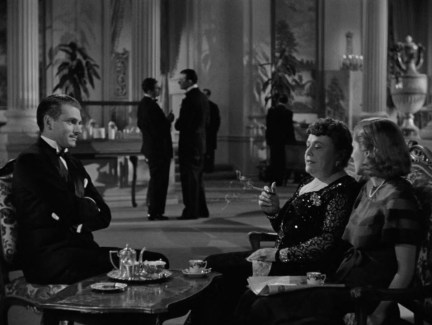 During her brief freedom, the young woman begins to spend time with the widower, Maximilian de Winter (Laurence Olivier). While their first introduction was odd, Maximilian was staring over a cliff and seemingly on the verge of suicide, the two quickly fall in love in a period of mere weeks. Their newly blossomed love is consummated in marriage, and the young woman has now become the new Mrs. de Winter. While the circumstances of the first Mrs. de Winter’s death have been briefly alluded to, the audience is only allowed to ascertain that she drowned in a boating accident.
As the modern setting of Monte Carlo is forgone for the Gothic charm and architecture of Maximilian de Winter’s palatial estate, Manderley, the movie takes a sinister change in tone. The new Mrs. de Winter is introduced to her staff in a scene similar to Annie entering the house of Daddy Warbucks, minus the song and dance but with the addition of the creepy mistress of the house, Madam Danvers (Judith Anderson). Madam Danvers wastes no time in making the new Mrs. de Winter feel inadequate, and incapable of filling the shoes of the first Mrs. de Winter. As the story progresses, we learn that Madam Danvers had a very close relationship with the first Mrs. de Winter, and that she could have had a possible Lesbian infatuation with her employer. This allegiance to her former employer makes Madam Danvers a direct threat to the new Mrs. de Winters and her acclimation to Manderley.
In classic Hitchcock fashion, the pleasant story that could have been unravels to reveal hidden secrets that have the possibility to derail the happy lives of the new Mrs. de Winters and her husband Maxime. It would be an injustice to Hitchcock to describe the twists and turns of the Master of Suspense’s narrative, so instead I shall conclude my commentary with my overall thoughts and feelings towards the film. 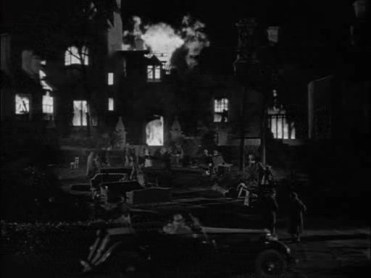 I certainly could not have predicted the chain of events that lead up to the destruction of Manderley. I also am not giving away any spoilers, because we are aware of the estate’s demise in the first scene of the film. I never read the Daphne du Maurier novel that the film was based on, but preliminary research indicates that the film was very true to the novel minus a few liberties it took to be in compliance with the production code. Hitchcock would go on to direct another classic film based on a Daphne du Maurier novel, 1963’s The Birds. While I did enjoy Rebecca, I would be lying if I said I wasn’t a little underwhelmed by the film compared to some of Hitchcock’s more provocative films like Rear Window, North by Northwest, Psycho, and Vertigo. However, compared to his films proceeding Rebecca, Hitchcock showed a clear stride forward under the supervision of David O’ Selznick. This film is worth watching for the creepy Madam Danvers moments alone, and I was very pleasantly surprised with the quality of this lesser known Hitchcock work.
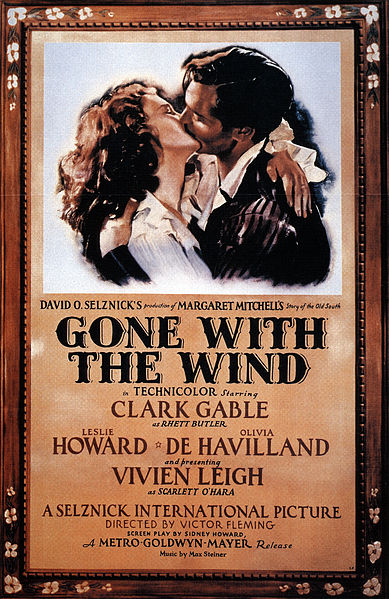
 Gone With the Wind may also be the film from the 1930’s that is most familiar to today’s movie goers. Of course, being our first Academy award winning film in Technicolor makes it much more accessible to audiences of today who view films in black and white with distain (I feel sorry for them as they don’t know the great movies they are bypassing – hopefully our blog has peaked their interest). Although not a definitive popularity measure, it is interesting that the well known Oscar winning film
 The process of Technicolor added an even more epic quality to the highest grossing film in history in terms of inflation adjusted dollars. While
  After all, the Civil War was fought over state’s rights and what power a federal governing body should have over an individual’s property. Do not read that statement as a belittling of human rights and the slavery issue, which was also an instrumental issue in the secession of the Southern states. This value of property and land was a continuance of a tradition that had lost traction in the progression of society, and the South vehemently wished to protect their neo-aristocracy. Rhett Butler describes the issues with waging war with the North in his sentiment that “all we [the South] have is cotton and slaves and arrogance.” This statement represents a clear foreshadowing of the impending disaster that will accompany the ill-fated war for independence.
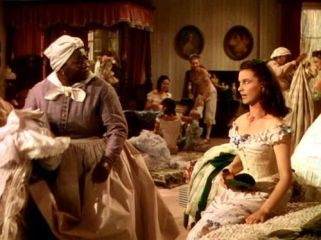 The role of Mammy (Hattie McDaniel) at least provided characterization and dimension for a change, compared to previous portrayals of black servants with no inkling of depth. I am very proud of the Academy for giving Hattie McDaniel the Oscar for Best Supporting Actress, because she delivered her performance with such power and grace that she demanded her accolades. Hattie was also the first black person to ever win an Academy Award, so she is certainly a trailblazer in the white-dominated Hollywood world. However, not all parts of the country were as accepting of McDaniel’s race as Hollywood. The Fox Theater in Atlanta refused to allow her to attend the premiere of the film because it was a White’s only theater, a fact that will always be a blemish on that fantastic venue. The portrayal of Prissy (Butterfly McQueen) was not as forgiving as that of Mammy, and has very patronizing emphasis on her high-pitched voice and child-like timidity.
 The Kindler Oscar Chronicles